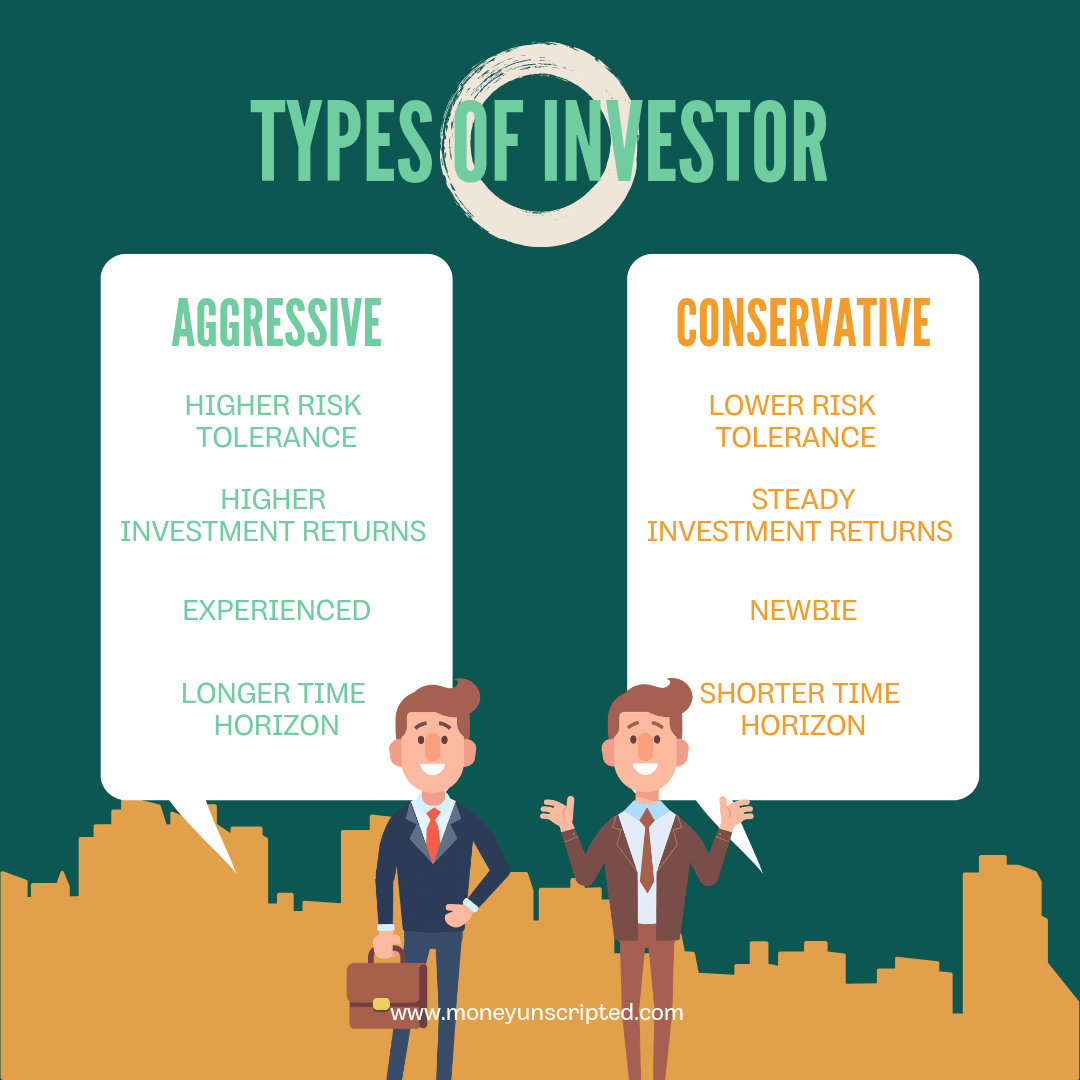
So what type of investor are you and why should you care?
Identifying your investor type will help you know the consequences of your investment style. You’ll learn the limitations and advantages that naturally result from the way you invest.
Editorial Note: We earn a commission fro partner links on Money Unscripted blog. Commissions do not affect our editors' opinions or evaluations.
Additionally, you’ll be able to decide if the opportunity available at the next level of investing is worth the effort by understanding what the next level of investing looks like.
There are lots of different ways to describe what type of investor you are.
How much risk are you willing to take?
Types of investors
If you take note of the kind of investors, you may broadly come across two brands of entirely opposite people. There can be those who lay low and go on to earn stable returns without any stress. These are the conservative stock investors. On the other hand, some are always up and running and closely watch market fluctuations. Such investors are the aggressive ones.
One primary point of distinction between the opposite two is their risk profile. However, other factors come into play. let us understand these classes of stock investors and how they build their portfolios.

Conservative Investors
A conservative portfolio is composed of safer investments, such as cash and bonds, rather than stocks, which are considered riskier since companies and industries can fall in and out of favor. If a conservative portfolio includes stocks, they tend to be large, well-known, stable companies—what are known as “blue chip stocks”—which are less likely to experience wild market swings.
A conservative portfolio is more appropriate for someone who has:
- A lower risk tolerance
- A shorter time horizon (typically considered less than three years, but could be shorter in the case of a goal like saving for a down payment)
- A desire for steady returns that prioritize preserving capital
Read: Types Of Stocks To Invest In
Aggressive Investors
An aggressive portfolio is more likely to include newer or less-proven companies or industries which have the capacity to realize large gains, but also potentially commensurate losses.
An aggressive portfolio is more appropriate for someone who has:
- A higher risk tolerance
- A longer time horizon (more than three years, with the most aggressive accounts typically held for at least 10 years)
- An appetite for higher returns
Read: How To Invest In Stocks: Step By Step Guide
How involved are you in making investment decisions?
Active Investors
In contrast, although this type of investor may also enjoy reading financial news, they also spend several hours each month watching over investments, and they are often first movers.
This person might want to be involved in every aspect of the investing experience—sometimes, this means they may be an active day trader who has an investment account at one or more online brokerages, or otherwise actively follows the stock markets, even if they don’t execute dozens of trades each month.
Overall, this kind of investor usually takes a more hands-on approach with their investments than the average person. The active investor might be emotionally invested in the process but perhaps restrained enough to not be checking too regularly.
Other traits of the active investor might include:
• Likes to own only select companies
• Doesn’t always invest in a diversified portfolio
• Wants full control over his or her investments
• Needs to know what investment terms mean
• Seeks to beat the market
The active investor might have a desire to learn how companies operate and an interest in learning about macroeconomic events—and, perhaps most challenging, they have the fortitude to not simply sell when the market is trending down.
Passive Investors
This may well be the most common type of investor, with traits that might include:
Lacks time to monitor investments
• Enjoys reading financial news
• Likes to own a little bit of a lot of things
• Seeks to match, not beat, the market
• Looks up to Warren Buffett
This type of investor might be unemotional about the process while being active in portfolio management. They have an understanding of multiple types of investments as well as their overall risks. Low-maintenance investors might maintain portfolios consisting of these more-traditional types of investments:
• Passive mutual funds
• Passive ETFs
• A few high-quality blue-chip stocks
In general, this type of investor is proactive when selecting investments, but less so when it’s time for balancing and maintenance.
Read: HOW TO READ A FACT SHEETS/MDDs
A passive investment strategy is good for people with busy lives, families, jobs, outside interests, or entrepreneurs building businesses.
Read: How Much Should I Save For Retirement
Understanding Your Risk Tolerance
It can help to also think more deeply about your own ability to deal with risk.
If you’re methodical, you might make your investment decisions based on cold, hard facts. Details matter to you and you refer to research when making decisions. This personality type, according to the CFA Institute, can also have a lower risk tolerance.
Personality types with a higher tolerance for risk include the spontaneous investor and the individualist. If you’re spontaneous, you may switch from one investment to another, perhaps on advice you’ve received or read about, or because of a popular fad.
Individualists, meanwhile, typically do plenty of research and make their decisions independently. They’re often more willing to take risks because they’re more confident in what they’ve researched.
Read: Tax-free Investment Account: frequently asked questions
Are you a risk-tolerant or risk-averse investor?
Risk-tolerant investors are more willing to invest in assets, such as stocks (aka equities) that have a chance of failure but also potential for a high return. Risk-tolerant investors are also more comfortable with market changes and volatility.
On the other hand, risk-averse investors prefer “safer” investments, such as bonds (though all investing carries risk).
To determine your own risk tolerance, consider both the risk you’re willing to take and the risk you’re able to take. Finding your personal distinction between these risk aspects could help you evaluate your investment choices.
Have you heard of DebtSafe? DebtSafe offers safe and secure debt consolidation.
More risk-tolerant investors and/or those with a longer time to reach their goal will lean toward an aggressive asset allocation (made up primarily of stocks).
More risk-averse investors and/or those with a shorter time to reach their goal will lean toward a conservative asset allocation (made up primarily of bonds).
If your risk tolerance and/or time to reach your goal is somewhere in the middle, you may want to consider a balanced asset allocation.
Read:GLOBAL INVESTING MADE EASY
No matter your investing style, the are few habits nearly all successful investors practice.
- Set a goal. Understanding why you’re investing is crucial to guiding the appropriate investment strategies.
- Discipline. Being disciplined about implementing your plan can help you avoid mistakes.
- Patience. Avoid trading based on emotions or in reaction to market changes, either bad or good, and don’t try to time the market. Investing is about time in the market, not timing the market.
- Diversification. A portfolio made up of a variety of stocks, bonds, and other assets can lend some protection from market volatility.
- Flexibility. Changes in life might mean you need to alter the course of your investment strategies, but always keep your goals in mind.
Are you an active or passive investor?
Not all investors want to spend time managing their own investments.
Active investors want to be involved in the research and analysis of what they’re investing in and the decisions that are made. These hands-on investors tend to have a higher risk tolerance and lean toward an aggressive asset allocation.
The passive investor prefers to set up investments and forget about them. Some investors may also take a hands-off approach by selecting passive investments, such as index funds, which are designed to track a benchmark (like a market index) and don’t require regular maintenance. This is known as passive investing.
Have you heard of FASTA short-term loans? FASTA gives you access to financial recources to buy what you need today with more time (up to 3 months) to pay.
Whether you’re an active or passive investor, it’s important to seek advice from a financial professional to help you find the right options as you work toward your goals.
What type of investor are you?
The categories above are also not mutually exclusive. An aggressive investor is often an active investor. Also depending on your life situation, you may transition from one to the other. As we explained above, someone may move their investments from an aggressive portfolio to a more conservative one as they get older.

Enroll in our investment guide series. We offer three investing courses.
[mc4wp_form id=”2003″]