Aviation is one of those industries most people admire from a distance. We see planes take off, land safely, and move millions of people across the world—but we rarely think about the people who make that possible behind the scenes.
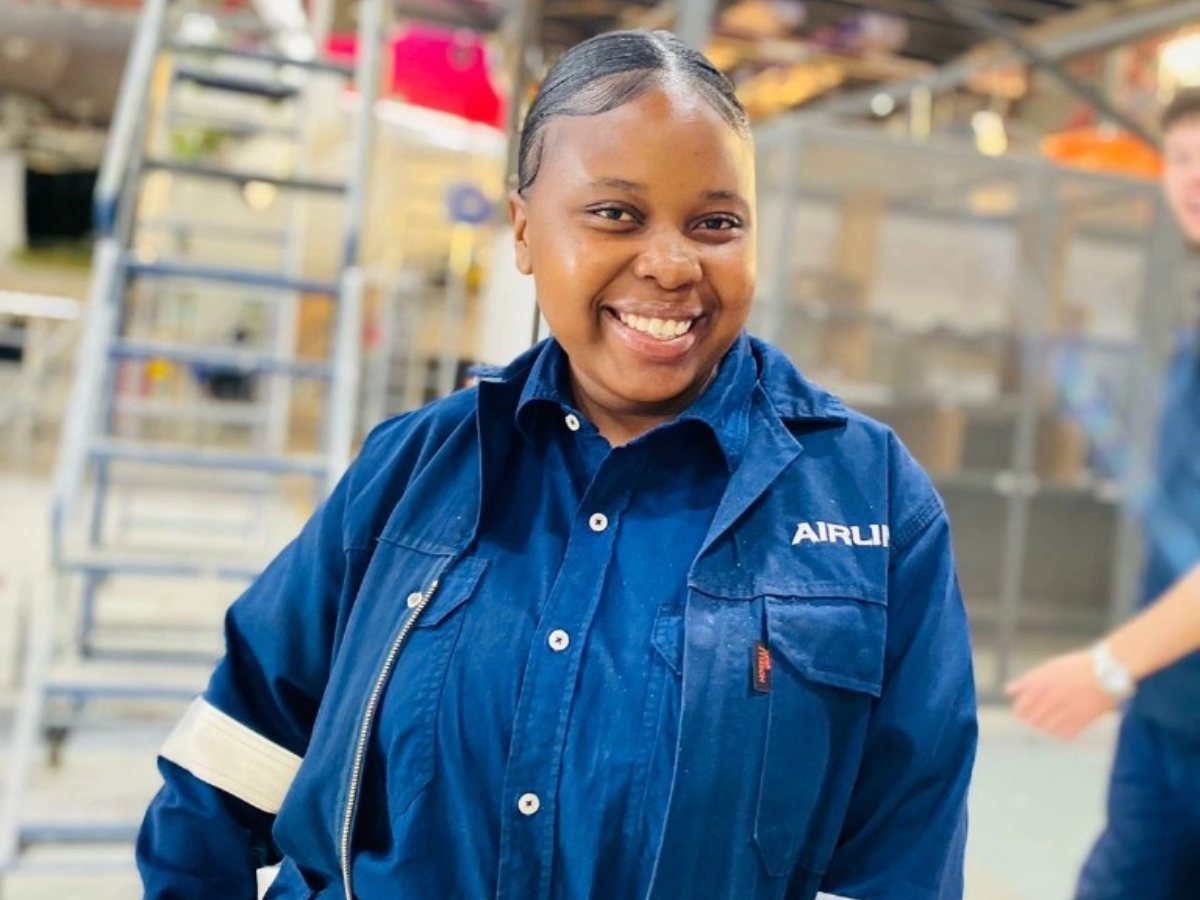
At just 22 years old, Sarah Mathonsi is one of those people. An aircraft engineer with a background in diesel mechanics, she represents a new generation of young professionals entering highly technical, often misunderstood fields—and thriving.
Her journey is not just about aircraft. It’s about resilience, discipline, and believing in yourself when the path isn’t clearly mapped out.
Humble Beginnings, Big Dreams
Born and raised in a small village in the North West, Sarah describes herself as curious, teachable, and deeply grounded in where she comes from. “I’m a village girl who believes where you come from does not limit where you go.” That belief would become the foundation of her journey into one of the most demanding and misunderstood careers.
Like many young people, her first exposure to aviation was limited. She only knew about pilots—not the engineers working behind the scenes. “I always knew about aviation, but I didn’t know about the engineering side,” she explains. It wasn’t until a career expo during matric that she discovered aircraft maintenance engineering.
That moment sparked something.
Choosing a Path Without a Blueprint
Without immediate access to aviation opportunities, Sarah made a strategic move—she pursued diesel mechanics.
It wasn’t the final destination, but it was a step in the right direction.
This decision reflects a powerful lesson: sometimes your first step isn’t your dream career—it’s your entry point.
“I knew I wanted to be an engineer. So even if it wasn’t aircraft yet, I stayed in a technical field.”
While studying, she continued seeking opportunities in aviation. Eventually, that persistence paid off, and she transitioned into aircraft maintenance training.
The Reality of Aviation Training
Moving from diesel mechanics into aircraft maintenance was not a smooth ride.
Aviation, as Sarah quickly learned, operates on a completely different level of precision and discipline.
“The pass mark was 75%, and to get a distinction was 85%. There’s no room for mistakes.”
The academic standards were significantly higher than what she was used to. Pass marks jumped to 75%, and distinctions required 85%. The pace was intense, with modules sometimes lasting only 20 days before exams.
On top of that, the content itself was unfamiliar.
“You’re still trying to understand what a wing is, how an aircraft flies… and then you’re already writing exams.”
But Sarah adapted quickly. Her ability to adjust, combined with discipline and hard work, helped her push through one of the most demanding training environments.
Learning in Real Life: From Theory to Aircraft
Unlike many careers where theory dominates, aviation training is deeply practical.
After completing theory, students are placed in real companies for practical training—working on actual aircraft under supervision.
This is where everything becomes real.
For 18 months, Sarah trained in live environments, learning directly from experienced professionals. It’s a high-stakes space where precision matters and mistakes are not an option. “You work on live aircraft. There’s always someone guiding you, but it’s real responsibility.”
This stage isn’t just about skill—it’s about trust, discipline, and consistency.
Proving Yourself in a Male-Dominated Industry
Aviation engineering remains a male-dominated field, and Sarah quickly learned that being a young woman in that environment came with added pressure.
“You constantly need to prove yourself… not just as a trainee, but as a woman.”
Despite this, she emphasizes that her experience has been largely positive. She was given equal opportunities to work, learn, and grow—just like her male counterparts. She secured a job almost immediately after qualifying—something many struggle to achieve.
Her experience also challenges common assumptions about women in technical fields.
“I’ve never felt like I don’t belong. We work equally.”
But the key difference? She had to show up with confidence.
“Your confidence is the one that speaks for you.”
Still, she emphasizes the importance of setting boundaries and maintaining professionalism, especially in environments where personalities and perceptions can be tested.
What the Job Really Looks Like
Aircraft engineering is not a desk job.
It’s physical, technical, and mentally demanding.
Contrary to popular belief, aircraft engineers don’t build planes from scratch—they maintain and ensure they are safe to fly.
A typical day in Sarah’s world depends on the shift.
On night shifts, Sarah works on heavy maintenance—changing components, engines, and conducting technical repairs. On day shifts, she focuses on inspections, ensuring aircraft are safe and ready for takeoff. “You might be working on an aircraft while passengers are waiting. You must stay calm and make sure everything is safe.”
The stakes are high.
“You’re working with people’s lives. You can’t fix something later—you must get it right the first time.”
To maintain safety, engineers rely heavily on manuals, strict procedures, and team verification systems. No one works alone, and every task is checked multiple times.
Discipline, Responsibility, and Pressure
If there’s one thing aviation teaches you, it’s discipline.
“Discipline keeps you from taking shortcuts. And in this field, shortcuts can cost lives.” Shortcuts don’t exist in this field. Every action must be precise, documented, and verified.
She also highlights the importance of:
- Accountability
- Confidence
- Continuous learning
- Emotional control under pressure
Sarah highlights accountability as one of the most critical traits. If something goes wrong, you take responsibility and fix it immediately.
Over time, working under pressure becomes second nature—but it requires emotional control and mental strength.
The Cost of Getting In—and Staying In
One of the barriers to entry is cost. Training can cost around R150,000, making access difficult for many.
However, Sarah’s story shows that funding opportunities, persistence, and alternative entry paths (like diesel mechanics) can open doors.
Even after qualifying, the journey continues. Engineers must gain experience, earn licenses, and continuously develop their skills.
In aviation, experience is everything.
Beyond Engineering: What’s Next?
Although she’s already accomplished so much, Sarah doesn’t see herself staying in one role forever.
She’s interested in further studies and exploring other opportunities within aviation—possibly even transitioning into other roles like air traffic control or different technical specialisations. But one thing is clear—her mission extends beyond her personal success.
Her long-term goal is bigger than just her own career.
She wants to inspire.
Representation and Giving Back
One of Sarah’s biggest missions is to expose more young people—especially young women—to aviation careers. “I want to guide young people, especially women, and show them that it’s possible.”
Many don’t even know these opportunities exist.
Through platforms like LinkedIn, she shares her journey to educate, motivate, and guide others.
“It’s possible. You just need to believe in yourself and work hard.”
A Career Worth Exploring
Aviation may not be the most visible career path—but it’s one of the most impactful.
Sarah’s story reminds us that:
- You don’t need to have everything figured out from the start
- Strategic decisions can lead you closer to your goals
- Discipline and resilience can open doors in the toughest industries
And most importantly:
“Where you come from does not limit where you go.”