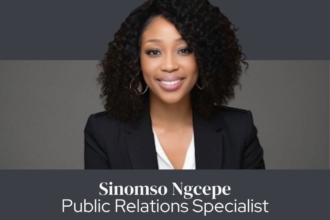
When people think about branding, they often think about logos, colours, slogans and social media posts. But behind every brand people trust, admire or remember, there is usually something deeper at work: strategy, storytelling, reputation management and relationships. That is where public relations comes in.
For Sinomso Ngcepe, a PR senior account manager and media relations specialist, public relations is far more than media coverage or polished messaging. It is about helping people understand who a brand is, what it stands for and why it deserves their trust. Her journey into the industry is also a reminder that sometimes the career meant for you is not the one you planned, but the one that finds you.
A Career She Did Not Plan For, But Grew To Love
Before she became a communications professional, Sinomso thought she would become a psychologist. She had always been interested in people, how they think, how they process life and how perspective shapes behaviour. But after matric, a delayed return from the holidays meant that psychology applications had already closed.
That setback could easily have felt like the end of the road. Instead, it became the beginning of a new one.
While exploring other options at Rosebank College, she was introduced to public relations by someone who saw something in her before she could fully see it herself. What started as an alternative quickly became a calling. She did not simply study PR. She fell in love with it.
That love would later matter, especially when the reality of the industry turned out to be far more demanding than the theory taught in class.
The Gap Between Theory and the Real World
One of the clearest lessons from Sinomso’s journey is that studying a profession and working in it are not always the same thing.
She describes the transition from college to the workplace as a shock. The theory gave her a foundation, but it was not enough to fully prepare her for the real demands of PR. The working world required more speed, more adaptability, more instinct and much more practical understanding than she had expected.
Like many graduates, she assumed her qualification would open doors immediately. Instead, she found that experience was what the industry really wanted. Before breaking into PR, she spent over a year working in a call centre, building the kind of communication and stakeholder skills that would later become useful in agency life.
That season mattered. It taught her how to deal with people, how to build rapport and how to operate in environments where tone, patience and communication are everything. Eventually, she secured an internship at a digital marketing agency with PR functions, and that became her entry point into the profession she now speaks about with so much conviction.
What PR Really Looks Like Behind the Scenes
Public relations is often misunderstood. Many people reduce it to events, media appearances or publicity, but Sinomso’s experience shows that PR is much broader and much deeper than that.
At its core, PR is about awareness, credibility and reputation. It is about helping people understand what a brand stands for, why it matters and why it should be trusted. It is also about managing communication when things go wrong.
In practice, that means PR professionals do far more than speak. They think. They plan. They write. They pitch. They prepare clients for interviews. They build media lists. They create strategies. They manage narratives. They respond to crises. They study audiences. They shape messaging. They decide what angle makes a story newsworthy and which media platforms are best suited to carry it.
A typical day can involve drafting press releases, profiling executives, planning campaigns, pitching journalists, preparing briefing documents and advising clients on how to position themselves publicly. In some cases, it may also involve navigating a crisis where timing, clarity and empathy are everything.
This is why Sinomso repeatedly stresses that PR is not light work. It may look polished from the outside, but behind every polished brand moment is usually a lot of unseen effort.
Communication Is the Real Foundation
If there is one academic lesson that stayed with her throughout her career, it is communication science.
One of her most influential modules taught her about encoding and decoding: how messages are sent, how they are received and how easily meaning can shift depending on the audience, the channel and the surrounding “noise.” That lesson has stayed with her because it reflects the reality of PR so clearly.
A brand can intend to say one thing, but if the message is poorly framed, badly timed or directed at the wrong audience, it can be interpreted very differently. This is why PR is not just about saying something. It is about understanding how that message will land.
That kind of communication awareness affects everything: how you pitch media, how you write a press release, how you prepare a client for an interview and how you speak to different generations and audiences. It is also why PR can work for both extroverts and introverts. The work is not only about being loud or visible. It is about being intentional, thoughtful and effective in how you communicate.
Why Media Relations Still Matter
Among all the parts of her job, Sinomso says media relations is what she enjoys most.
For her, strong PR is built on strong relationships. Not transactional ones, but real professional relationships rooted in trust, relevance and mutual respect. She is clear that this does not mean unethical favours or shortcuts. It means understanding journalists, respecting their time, knowing what they cover and bringing them stories that actually matter to their audiences.
Good media relations, in her view, are built through consistency and human connection. Sometimes that means checking in without asking for anything. Sometimes it means doing a soft pitch before sending a full story. Sometimes it means taking feedback seriously and refining an angle so that it is more useful, more timely and more newsworthy.
This is where many brands and even PR people get it wrong. They pitch widely instead of strategically. They send irrelevant stories. They fail to personalise emails. They follow up too aggressively. They focus on quantity instead of quality. But a strong PR professional understands that media relationships are long-term. They are built over time and maintained with care.
Building a Brand Is More Than Being Seen
One of the most important ideas in Sinomso’s interview is that PR helps brands go beyond visibility.
Social media can create attention. Advertising can drive sales. Marketing can push campaigns. But PR helps people understand a brand’s character. It builds the kind of credibility that cannot simply be bought.
This matters because visibility without trust is fragile. A brand may be known, but that does not automatically mean it is respected. PR helps close that gap. It tells the deeper story. It gives context. It puts thought leaders forward. It creates space for education, explanation and connection. It allows a brand to build long-term trust instead of relying only on short-term attention.
That is also why PR becomes especially important during difficult moments. When a crisis hits, a brand cannot rely on silence, vibes or aesthetics. It needs clarity. It needs structure. It needs empathy. It needs a response that is both fast and accurate.
The High Stakes of Reputation Management
Sinomso speaks about crisis communication with the seriousness it deserves.
For her, one of the biggest mistakes brands make is waiting too long to respond or failing to communicate with honesty and transparency. Trust can take years to build and seconds to lose. Once customers feel ignored, dismissed or misled, the damage can spread quickly, especially in the digital age.
Her perspective is practical: brands must be proactive where possible and reactive with speed when necessary. A crisis needs to be acknowledged. Stakeholders need answers. Media need statements. Audiences need reassurance. And none of this can be handled carelessly.
She also makes an important point about speed and accuracy. In a crisis, you do not get to choose one over the other. Both matter. A fast response that is inaccurate can make matters worse. A perfectly accurate response that comes too late can lose the narrative completely.
Handled well, though, even a crisis can become an opportunity to rebuild trust. Customers pay attention not only to what went wrong, but to how a brand responds when things go wrong.
Lessons for Young People Entering PR
For anyone considering a future in public relations, Sinomso’s advice is simple: choose it because you genuinely love it.
PR is not for people who are only attracted to appearances. It is for people who are curious, resilient, strategic and willing to work. It is for people who want to understand audiences, shape narratives and help brands communicate with purpose.
She encourages young professionals to build strong soft skills early. Communication matters, but so do emotional intelligence, adaptability, writing ability, research skills and the ability to deal with different personalities and pressures. She also warns against chasing titles or money too early. Growth in PR should be built on knowledge, skill and experience, not just ambition.
In her own journey, what mattered most was not simply talent. It was also the people who poured into her. Lecturers, mentors, managers and colleagues all helped shape the professional she became. That is why she speaks so strongly about mentorship and the responsibility to help others rise as well.
A Career Built On Purpose, Growth and Grace
Now approaching a decade in the field, Sinomso reflects on her career with deep gratitude. One of her proudest achievements is that many of the brands she once wrote down as dream companies are now brands she has worked with or represented. She did not always join them internally, but she still got to help shape their public narratives from the PR side.
That kind of full-circle moment says a lot about her journey. It is a reminder that careers do not always unfold in the exact way we imagine, but purpose has a way of finding expression when we stay open, committed and willing to grow.
The legacy she wants to leave is not just one of title or prestige. It is one of kindness, quality, reliability and being easy to work with. In an industry built on communication and relationships, that may be one of the strongest brands a person can build for themselves.