Medicine is more than a career—it’s a calling. For Dr. Ntshembo Nkuna, that calling was rooted in childhood experiences that shaped her perspective on healthcare. From an early age, she knew she wanted to be a doctor, driven by a deep desire to help those around her. Now, as a General Practitioner with a postgraduate diploma in Public Health, she shares her journey, challenges, and vision for the future of healthcare.
A Childhood Dream Rooted in Experience
For Dr. Nkuna, the journey to medicine started long before she set foot in medical school. “I think I was about seven or eight years old, in Grade 2, when I realized I wanted to be a doctor,” she recalls. Seeing her mother frequently ill and struggling with dietary restrictions left a lasting impression on her young mind. “It used to hurt me so much because I didn’t understand what was going on.”
Her maternal grandmother also played a significant role in shaping her aspirations. Living in a rural village, her grandmother had monthly check-ups with a doctor, but language barriers often left her feeling uninformed. “Each time she went, I’d ask her how it was, and she would just say, ‘They speak English, so you just agree to whatever they say.’ That really bothered me,” she says. “I told myself that when I become a doctor, I will try to speak as many languages as possible so my patients can fully understand their treatment and feel comfortable asking questions.”
These early experiences shaped her mission—not just to heal, but to ensure that patients, especially in marginalized communities, feel seen and heard.
Finding Her Path in Medicine
Initially, Dr. Nkuna was convinced she wanted to specialize in treating women. “Back then, I didn’t know about obstetrics and gynecology, but I just thought, ‘I want to be a doctor for women because I don’t want women to be sick.’” However, medical school opened her eyes to new possibilities. “I realized I didn’t actually like that. What I did love was primary healthcare and psychiatry.”
During her community service, she worked in psychiatry and found it incredibly fulfilling. “Mental health is something that’s still not fully understood, especially in the Black community. I wanted to help change that—to make people see that conditions like schizophrenia and depression are just like any other medical condition.”
Despite her passion for psychiatry, the reality of working in the public healthcare system proved challenging. “Because of how the government is set up, I didn’t have a provincial government post after my community service. So, I found myself unemployed for a while before moving into the private sector, working in emergency departments.”
Now, she is looking toward corporate healthcare. “I love clinical medicine, but I also want to take a step back and explore health systems, policy, and management. I want to understand where the gaps are and how we can improve healthcare delivery.”
The Challenges of Being a Doctor
Medicine is a demanding profession that requires immense personal sacrifice. For Dr. Nkuna, the hardest part has been missing important life events. “Christmas, New Year’s, family birthdays, even funerals—I’ve missed so many because of work. It’s tough, but my family and friends understand. We always try to make up for it, even if it’s not the same. I joke with my best friend that we put birthdays in a container and freeze them until we’re both available.”
A Day in the Life of a GP in the Emergency Department
Currently, Dr. Nkuna works in a private hospital’s emergency department, where no two days are ever the same. A typical 12-hour shift (7 AM to 7 PM) begins with handovers from the night doctor. “They tell me which patients are still in the unit, who needs review, who’s waiting for admission. Then, I set up my workspace—making sure I have all the necessary documents, my stethoscope, stamps, and a bottle of water. And then, the chaos begins.”
Her day is a whirlwind of treating everything from minor ailments to life-threatening emergencies. “Gunshot wounds, heart attacks, strokes, diabetes, hypertension—you name it, I see it.” People don’t always understand what the emergency department is for, but in a private hospital, they pay for it, so we see everything.”
Occasionally, she gets called for code blues, requiring her to rush to ICU for emergency resuscitation. “Some days, we save lives. Some days, we don’t. But we always debrief and learn from every case.”
One principle that guides her in her daily patient interactions is Colossians 3:23—“Do everything as though you are doing it for the Lord and not for men.” This verse keeps her grounded, reminding her to serve each patient with excellence and compassion, no matter how tough the day gets.
The Emotional and Physical Toll of Medicine
Being a doctor isn’t just physically exhausting—it’s emotionally draining too. “People say we carry the weight of life and death decisions, but I don’t see it that way. I do my best, and my best is all I can do,” she says. Experience has taught her that not every patient can be saved. “Some patients go home, some get admitted, and unfortunately, some never leave the hospital alive.”
To cope, she leans on her support system. “My husband always knows when I’ve had a rough day. If I get into the car looking grumpy, he just lets me breathe before we talk about it. Sometimes, I call my sister or my best friend, and we just debrief.
At work, doctors lean on each other for support. “When we lose a child, for example, we take time to debrief as a team. And yes, we cry—real tears because at the end of the day, we are human too.”
A Moment That Reaffirmed Her Purpose
In the midst of the chaos, there are moments that remind Dr. Nkuna why she chose this path. “One experience that stands out was when a patient came in stabbed in the chest with a pneumothorax, he was struggling to breathe, distressed and couldn’t even finish sentences. I quickly put in an intercostal drain for him and he got instant relief such that he wanted to go home.”
Lessons Learned and Advice for Aspiring Doctors
Becoming a doctor requires years of intense study and sacrifice. Looking back, Dr. Nkuna wishes she had known just how much the profession would demand of her. “It’s not just about intelligence; it’s about resilience. If you’re considering medicine, know that it will take a lot from you, but if it’s your passion, it will also give back in ways you never imagined.” She also wishes she had known just how emotionally taxing medicine can be. “You prepare for the academics, the exams, the long hours—but no one tells you about the emotional burden of losing patients, of missing your loved ones’ milestones.”
Her advice to aspiring doctors? “Make sure you really want this. Medicine is not just a career; it’s a lifestyle. You will make sacrifices, but if healing people is truly your calling, it will all be worth it.”
The Future of Healthcare
Medicine is constantly evolving, and Dr. Nkuna believes the biggest shift has been in patient expectations. “Patients are more informed now, thanks to the internet, but that’s not always a good thing. There’s a lot of misinformation out there.” She also sees an increasing emphasis on mental health. “It’s encouraging to see more conversations about mental health happening in our communities, but we still have a long way to go.”
Looking ahead, she hopes to be part of the change. “I want to contribute to improving healthcare systems, making sure people—no matter where they are—get quality care.”
Breaking the Myth: Doctors Are Human Too
One of the biggest misconceptions about doctors is that they’re invincible. “People think we have all the answers, but we don’t. We’re constantly learning, just like everyone else,” she says. If she could change one public perception, it would be the expectation that doctors should never make mistakes. “We do our best, but we’re human. We have limits, and sometimes, things are out of our control.”
Beyond Medicine: Striving for Balance
Despite her demanding job, Dr. Nkuna believes in maintaining a life outside of medicine. “Balance is tricky, but I try to make time for things that bring me joy. I love cooking and baking it allows me to try out new recipes, spending time with family, and just having moments where I’m not ‘Dr. Nkuna’ but simply Ntshembo.”
She also wants people to understand that doctors are not invincible. “We are not superheroes. We get tired, we grieve, we struggle. People think we don’t have emotions, but we do. We just learn to carry them differently.”
Despite the challenges, Dr. Nkuna remains deeply committed to medicine. “Even on the hardest days, I remind myself why I started. Every patient I help, every life I touch—it reaffirms my purpose.”
About Dr. Ntshembo Nkuna
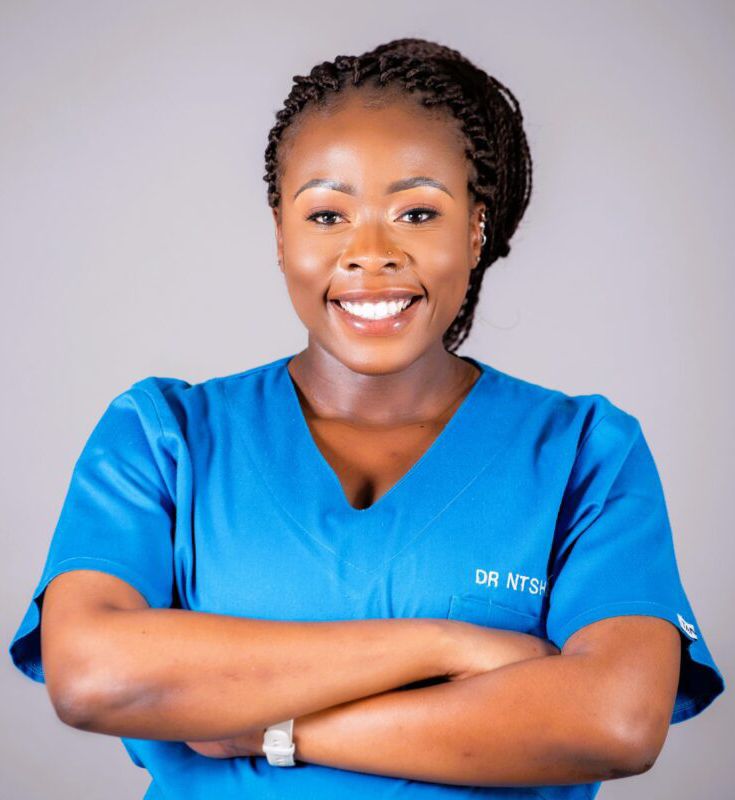
Dr. Ntshembo Nkuna is a General Practitioner with a postgraduate diploma in Public Health. She obtained her medical degree from Stellenbosch University and later pursued further studies at the University of Pretoria. Passionate about primary healthcare and mental health advocacy, she is currently working in emergency medicine while exploring opportunities in corporate healthcare.
Dr. Nkuna is also available for telehealth (virtual consultations) for those seeking medical advice remotely. If you’re interested, you can reach out via info@dnnp.co.za.
Fun fact: Her teeth appear whiter than they actually are due to her black gums—a unique feature that often surprises people.
Dr. Nkuna is driven by a vision of patient-centered care, where language and cultural barriers do not stand in the way of effective treatment. Whether in a clinical setting or shaping healthcare policies, she remains committed to making a difference in people’s lives.