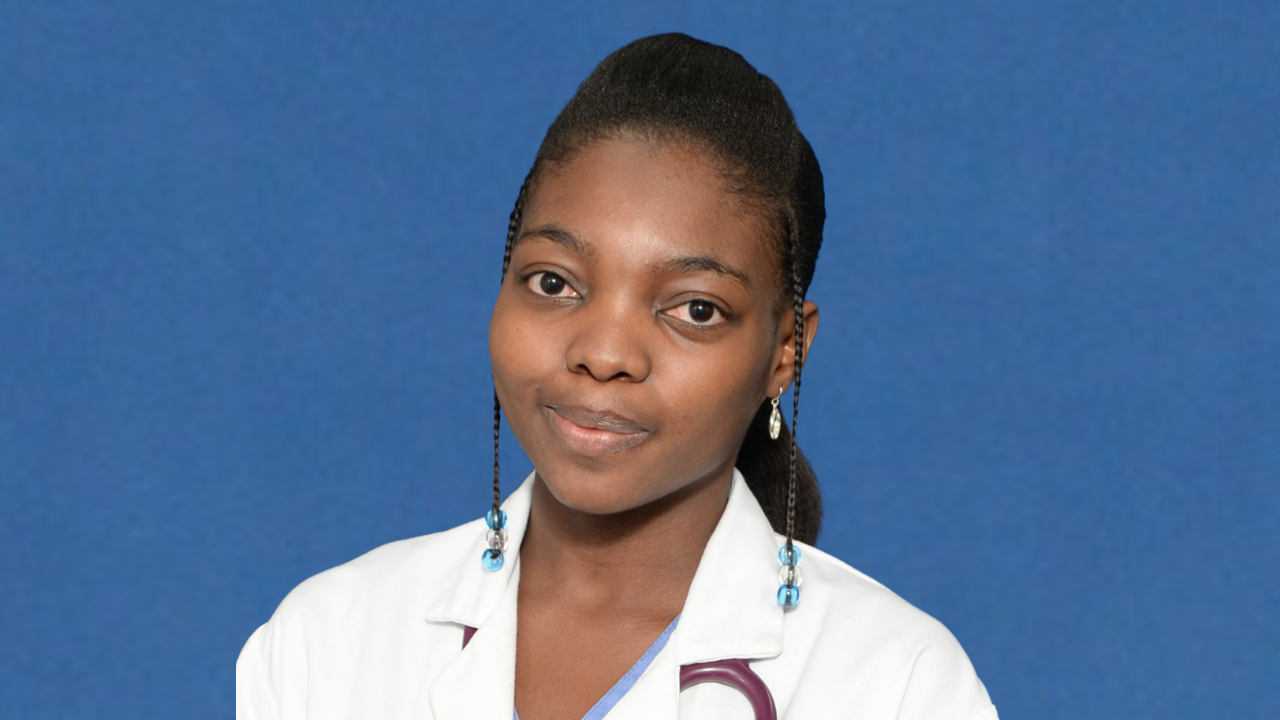
A little girl once refused to give back a toy stethoscope after playing a doctor in a Grade R school play. Years later, that childhood insistence would take Dr. Beauty Mahomane through academic detours, financial uncertainty and the demanding reality of medical school. Her journey to becoming a doctor is not simply about medicine but about a dream that refused to die.
For Dr. Beauty Mahomane, becoming a doctor was never a carefully calculated career decision. In fact, she cannot remember exactly when the dream began. What she does remember is being in Grade R, taking part in a school play where she was given the role of a doctor, and refusing to give back the stethoscope afterwards. “I kept on saying I want to be a doctor,” she recalls. From that moment, the dream stayed with her, even as the road towards it became far more complicated than she had imagined.
Over the years, life itself seemed to reinforce that childhood ambition. Her mother became ill, followed by her younger brother, who was severely sick at one point. Instead of making medicine feel distant, those experiences strengthened her desire to understand illness and eventually help people through it. “My dream just never had a chance to die down ever since Grade R,” she says. Today, that childhood certainty has evolved into a specific ambition: to become an internal medicine specialist and ultimately a cardiologist.
When the Medical School Dream Took a Detour
Getting into medical school, however, was not straightforward. While still in Grade 11 and preparing for applications, Mahomane had already convinced herself that Wits was financially out of reach. Coming from a family where money was limited, she believed applying would be pointless because she would not be able to afford it. She applied to several other universities, including the University of Pretoria, the University of Cape Town and Stellenbosch University, but admission did not work out.
Medicine remained the goal, so she refused to sit at home and wait for another opportunity. Instead, she pursued other studies while continuing to look for a way into medical school. She completed a degree in Biomedical Technology and also spent a year studying Chemical Engineering, hoping that eventually she would qualify for the GEMP programme and enter medicine through another route. “I just didn’t want to take a gap year. I didn’t want to sit at home,” she explains.
There was also an unexpected twist to the financial concerns that had initially kept her from applying to Wits. After matric, Mahomane finished among the top three learners at her school and received a GCRA bursary. In hindsight, the financial barrier she had imagined was no longer necessarily a barrier. “I could have been able to afford being in medical school at Wits because of that bursary, but I hadn’t applied,” she says. “Unfortunately, I shot myself in the foot.”
Eventually, the alternative route worked. After completing her degree, she qualified for the GEMP programme, wrote the entrance examinations and was accepted into medicine. At the same time, she had also been accepted by UCT as a first-year student. For Mahomane, the decision was obvious: starting medicine from third year through GEMP made far more sense than beginning again from first year. “I definitely chose to start from third year,” she says.
From Biomedical Technology to Medicine
Her earlier academic experiences may not have been part of the original plan, but they became unexpectedly useful once she entered medical school. Biomedical Technology gave her an understanding of the laboratory side of medicine, something that became particularly valuable when she began working with patient investigations.
She understood the importance of collecting the correct specimen, taking an adequate amount and knowing which type of sample was required for particular tests. That knowledge helped her avoid having laboratory investigations rejected and, consequently, having to subject patients to another blood draw or invasive procedure. “The fact that Biomedical Technology is basically the background of medicine was very, very helpful,” she explains.
Her Biomedical Technology background also gave her some understanding of the financial side of laboratory testing. Having previously worked in the private sector, she had an appreciation of how expensive certain investigations could be. That perspective shaped the way she thought about requesting tests and using healthcare resources responsibly.
Chemical Engineering, meanwhile, was less directly connected to her eventual medical career, but it kept her academically active and gave her a foundation in areas such as physics and calculations. More than anything, her years of studying before medicine meant she never really stepped away from being a student. “Me being on books constantly helped me to transition better into medicine,” she says.
The Reality Behind the Achievement
From the outside, academic achievements can make a difficult journey look effortless. Mahomane made the Dean’s List more than once during medical school, but the achievement tells only one part of the story. Behind those results was a student who was studying consistently while carrying significant personal and family responsibilities.
Her motivation was not simply the desire to become a doctor. As the eldest child, she felt a responsibility towards her family and knew that her success could affect the lives of the people around her. She even shared part of her student stipend with her family while studying. “My biggest motivator was knowing that without me, the family is just stuck where they are,” she says.
Her deepest motivation was particularly personal. She wanted to change the circumstances her grandmother was living in and imagined a future where she could provide her with a safer, more comfortable home and basic household necessities. “I just wanna see my grandmother in a house,” she says. “I want to see her having a proper TV, I wanna see her having a proper stove or fridge.”
That responsibility gave her a reason to continue when medicine became overwhelming. But Mahomane also genuinely enjoyed learning. She liked knowing more, being able to answer questions during ward rounds and discovering that something she had studied could suddenly become useful in practice. Her approach was therefore not to cram immediately before examinations but to build knowledge continuously.
Her routine was intense. She would go to sleep early and wake up at around half past three in the morning to study before the day began. By the time examinations arrived, she was not trying to learn everything from scratch. She was revising material she had already worked through repeatedly. “Instead of me studying something as a new thing, I would actually be revising and then revise again and then revise again until the exams,” she explains.
Finding Someone Who Understood
But discipline alone could not make medical school manageable. There were moments when the pressure became overwhelming, including anxiety, crying and breakdowns. Mahomane says there were occasions when she found herself studying while crying, a powerful reminder that academic success does not necessarily mean that the journey was easy.
One of the most important people in that journey was her friend Camilla. The two were in the same class and even in the same group, which meant they understood the pressures they were experiencing in a way people outside medicine sometimes could not. When one of them reached breaking point, they would talk, cry, complain and eventually return to their work.
“We’d literally be each other’s therapist,” Mahomane says. Their friendship became a support system built around shared experience. She believes there is particular value in having someone who understands the specific pressure of medical training rather than having to constantly explain why something feels overwhelming.
Professional support also became important at another point in her life when she was dealing with a personal issue and realised that a friend was not enough. She accessed counselling through Wits, something she appreciated having available to her. But throughout medical school, the presence of someone who could simply understand what she was experiencing remained invaluable. “You don’t feel alone,” she says. “And that’s very important, not feeling alone.”
Learning to Navigate a Place Where You Feel You Belong
For Mahomane, one of the hardest parts of medical school was not simply the workload. It was the feeling that she did not belong. She recalls being one of only two Black students in her group and experiencing situations where practical circumstances, particularly transportation, placed her and Camilla at a disadvantage.
While some students had cars and could arrive early, stay late or travel between hospitals more easily, Mahomane and Camilla depended on the university bus. That meant their ability to volunteer for additional work or arrive at certain times was restricted by transportation schedules. Yet, from their perspective, those circumstances were sometimes interpreted as a lack of commitment.
The experience left them feeling excluded. “You always felt like you don’t belong,” she says. What made the experience particularly difficult was that the behaviour was subtle enough to make them question whether they were imagining it.
Having Camilla beside her helped Mahomane make sense of those experiences. When both of them noticed the same patterns, she could recognise that what she was experiencing was not simply something happening in her head. Their friendship became important not only as emotional support, but as a way of validating each other in an environment where they sometimes felt invisible.
The Moment Medicine Became Real
Despite the challenges, there were moments that reminded Mahomane exactly why she had chosen medicine. One of the most memorable happened during her cardiothoracic surgery elective, where she spent time observing a procedure involving ECMO and the heart.
As the surgical team prepared to take the patient off ECMO, everyone waited to see whether the heart would begin beating independently. For Mahomane, the atmosphere changed completely when it did. The quiet theatre erupted into celebration.
“It felt like my achievement when I didn’t do anything,” she recalls. Yet the experience left a lasting impression. Seeing a human heart restart after such an intensive procedure made medicine feel tangible in a way textbooks never could. “This is why I do medicine,” she remembers thinking.
That experience also strengthened her interest in cardiology and cardiothoracic medicine. It was a reminder that beneath the examinations, long hours and difficult circumstances was the reason she had wanted to become a doctor in the first place: the possibility of being part of something that could profoundly change a patient’s life.
The Skills That Matter Beyond the Textbook
Mahomane believes aspiring doctors should not underestimate the practical skills they develop during medical school. Procedures that may initially appear basic can become essential once a student enters internship and begins carrying greater responsibility.
Her advice is to learn as much as possible while still a student rather than assuming that every practical skill can be picked up later. “Don’t leave any skill for last,” she says. “Make sure you get the skills and you’re proficient in it.”
Her reasoning comes from experience. Medical graduates can find themselves working in different hospitals with different levels of staffing and resources. The transition into internship therefore requires more than academic knowledge. Having already developed practical skills can make the difference between learning something from scratch and being able to perform it with greater familiarity under appropriate supervision.
Discovering the Medicine That Excites Her
Among the different areas she encountered during training, internal medicine stood out to Mahomane because of its breadth. She was fascinated by the range of conditions an internal medicine specialist needs to understand, from cardiovascular and respiratory conditions to neurological and autoimmune diseases.
To her, the field represents a kind of broad medical expertise before further specialisation. “When you’re specialising in internal medicine, Jay, you’re just… to me, it feels like, my gosh, you’re such a super doctor,” she says.
Emergency medicine and trauma also left a strong impression, particularly during her rotation at Charlotte Maxeke Johannesburg Academic Hospital. The environment exposed her to the intensity of emergency care and the difference that resources, staffing and a well-run department can make to patient care.
Those experiences brought back the excitement she had felt about medicine. “When you see what resources can do for a patient,” she says, “it makes you feel like, yeah, this is why I wanna be a doctor.”
A Future in Cardiology, But Not Just Anywhere
Today, Mahomane’s immediate concern is more practical. Like many newly qualified doctors navigating the current employment landscape, securing a job and a source of income is an important priority as she plans the next stage of her life.
Her long-term vision is clearer. She wants to specialise in internal medicine, pursue cardiology as her subspecialty and eventually become a consultant. But there is another part of her ambition that matters just as much: returning home.
Mahomane dreams of eventually working at a hospital close to where she grew up, including facilities such as Mapulaneng or Matikwane Hospital. She knows the healthcare system has given her plenty of reasons to question whether meaningful change is possible, yet she has not completely lost faith in the idea. “For some reason I still have that hope,” she says.
Her ambition is not simply to hold a senior medical title. She wants the community to recognise that one of their own has returned. “Now one of our own is home,” she imagines. It is an understated but powerful vision of success: becoming highly qualified, then using that knowledge where it can have meaning for the people and place that shaped her.
What She Wants Future Doctors to Know
Mahomane’s advice to aspiring doctors is notably different from the glossy version of medicine that students may encounter from the outside. She does not encourage anyone to choose medicine simply because of its reputation, status or perceived earning potential.
“Don’t go in for the money,” she says. For her, the reality of medical careers is more complicated, with changing contracts, demanding working conditions and uncertainty around employment after training.
She also wants prospective students to understand that qualifications and additional courses do not automatically guarantee employment. Her advice is to investigate the profession honestly before committing to it. “Make sure you know why you wanna go in and make sure that reason is worth it,” she says.
For young people considering medicine, she recommends exposure before making the decision. They should understand what the work actually looks like, what the healthcare system demands and what life can be like for doctors beyond the moments that make the profession appear glamorous on television. She jokes that if her own daughter wanted to study medicine one day, she would first ask whether she had considered engineering or chartered accountancy.
Yet after everything she has experienced, Mahomane has no desire to exchange medicine for another career. The journey has tested her academically, emotionally and personally, but the original dream has remained remarkably intact.
From a little girl who refused to return a toy stethoscope after a Grade R play to a doctor planning a future in cardiology, her story is ultimately about persistence. The circumstances around the dream have changed, and so has her understanding of medicine, but the desire at its centre remains the same. “I don’t want anything but medicine,” she says.
And perhaps that is what makes Dr. Beauty Mahomane’s story worth telling: not because the road was easy, but because after everything it demanded from her, she is still walking it.